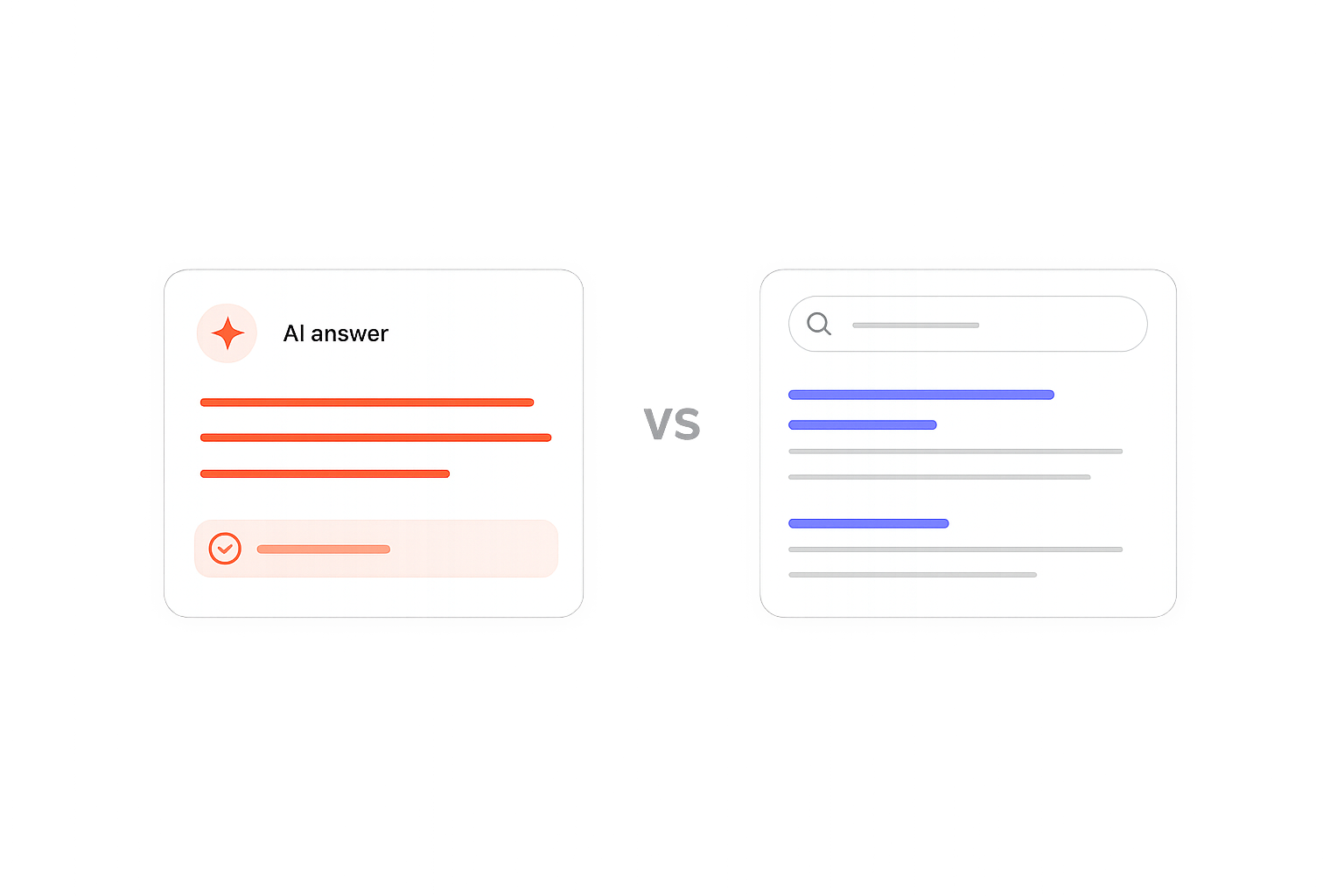
Search results are no longer just a list of blue links. AI platforms like ChatGPT, AI Overviews, Claude and Perplexity now give people direct answers, sometimes before they ever reach a traditional search results page.
This shift is redefining how customers discover information and interact with brands. As users move fluidly between search engines, AI assistants, and apps, the traditional SEO playbook must adapt. Enter Answer Engine Optimization (AEO).
What Is Answer Engine Optimization (AEO)?
Answer Engine Optimization (AEO) is the process of structuring your content so answer engines can easily extract, synthesize, and present it as a direct answer to user questions.
Unlike traditional SEO, which focuses on rankings, AEO focuses on answer inclusion. The goal is to have your content cited by AI systems as the trusted source.
AEO applies core SEO principles to this new reality, but it requires rethinking how success is defined. Instead of optimizing for clicks, you're optimizing for visibility within the answers AI provides, whether or not the user ever lands on your site. Take some time to understand the differences, and why answer engine optimization is a large part of the future of search visibility.
AEO vs. SEO: What's the Difference?
SEO and AEO work best together.
Strong SEO helps your content get discovered by LLMs because AI platforms rely on search indexes and trusted web sources to find information. Studies show how often AI platforms pull from top search results:
- 38% of AI Overview citations pull from Google's top 10 search results Source
- Pages ranking #1 in Google were cited 3.5x more often than pages outside the top 20 SERPs Source
- 60% of Perplexity citations overlap with the top 10 organic Google results Source
AEO builds on the SEO foundation by making your content easier for LLMs to understand, extract, and ultimately cite. That means placing extra emphasis on using answer-first sections, anticipating follow-up questions, and making sure AI crawlers can access your content.
A simple way to think about it:
Traditional SEO optimizes for the "best page." When someone searches "hotels in Greenpoint Brooklyn with parking," your page needs to match the full search intent to perform well in search results. That means including hotel information, parking details, amenities, location, pricing, reviews, and photos to satisfy the user intent.
AI Search prioritizes the "best answer." For that same query, AI places more weight on content that directly answers the specific need, such as whether the hotel offers parking, whether parking is free or paid, where guests can park, and how close the hotel is to Greenpoint.
The goal is to create content that is thorough enough to perform in search and clear enough to be cited in AI answers.
Key differences between AEO and SEO
| Area | AEO | SEO |
|---|---|---|
| Primary goal | Be the direct, cited answer in AI-powered results (ChatGPT, Gemini, etc.) | Rank high on traditional search engine results pages (Google, Bing) |
| How results appear | AI delivers one synthesized answer with source credits and follow-up links | Search engines list multiple sites in order of relevance |
| Content focus | Specific text segments and answer-ready chunks | Full web pages and site architecture |
| Success metrics | Mentions, citations, AI visibility | Keyword rankings, organic traffic, CTR |
How AI Search Works
The biggest difference between AI and traditional search is how they interpret a query.
A traditional search engine treats a long, detailed query as one string of keywords. For example:
Google might return a list of pages matching some, but not all, of those criteria, leaving you to click through and piece together the answer yourself.
AI search engines take a different approach. Using a technique called query fan-out, they often break the query into smaller, focused searches like:
- Best acoustic guitars under $1,000
- Acoustic guitars for fingerpicking
- Beginner-friendly acoustic guitars
- Sustainable guitar brands
Then, AI looks for the most relevant information across multiple sources and combines it into one answer. Depending on the prompt, that information may come from the model's internal training data, live search results, or both.
How to Optimize for AEO
The fundamentals haven't changed: understand your audience, build trust, and provide the best answers.
AEO isn't about reinventing the wheel, it's about taking what already works in SEO and adjusting it for how AI systems find and use content today.
The strategies below show how to future-proof your approach, blending proven SEO tactics with the nuances of AI-powered search.
Create topic clusters
Aligning your content with AI's query fan-out can improve visibility for your core topics and more specific long-tail searches. The most effective way to do this is by building topic clusters.
Topic clusters help search engines and LLMs understand how your content fits together. They not only show that you understand the main topic, but also semantically related subtopics, and how those ideas connect.
Instead of writing one long blog post that briefly covers ten different points, build a cluster around the topic. Create one pillar page for the broader query, then link to supporting pages that answer more specific follow-up questions.
Let's say you're an online guitar shop. Here's how you might build a topic cluster:
- Pillar page: best guitars for beginners
- Cluster pages: acoustic guitars under $500, best electric guitars for kids, how to choose your first guitar, guitar accessories for beginners, guitar picks for beginners, should i learn acoustic or electric guitar
This structure tells LLMs that your brand has the answer to the main question and the follow-up questions it will generate.
Optimize for chunk-level retrieval
AI extracts the most relevant passages, not entire pages. That means each section of your content needs to be clear, focused, and easy to understand on its own.
Each section should:
- Cover one specific question or subtopic
- Answer the query without requiring the full article
- Use descriptive H2s and H3s
- Keep paragraphs short and direct
- Avoid relying too heavily on earlier sections of the page
A sneaker brand targeting "What running shoes should I buy?" could make the page easier for AI to extract by breaking recommendations into clear, self-contained sections like:
- H2: Best overall running shoe
- H2: Best for racing
- H2: Best cushioned
- H2: Best lightweight
- H2: Best for stability
- H2: Best for trail
- H2: What to know before you shop for shoes
This structure makes it easier for AI systems to extract a specific answer and understand what each section is about without needing the full page for context.
Demonstrate E-E-A-T
LLMs are more likely to trust content that is credible, current, and backed by real expertise. The best way to build that trust is to clearly demonstrate E-E-A-T: Experience, Expertise, Authoritativeness, and Trustworthiness.
Your content should make it easy to verify who created it, why they are qualified, where the information came from, and when it was last reviewed.
This is especially important for topics where accuracy matters most, like finance, healthcare, legal, insurance, wellness, or safety.
An investment platform creating a "Beginner's Guide to Investing" could demonstate E-E-A-T by:
- Having a certified financial planner write or review the article
- Linking to an author page that explains their financial experience
- Citing reliable, up-to-date sources for key claims
- Showing a clear last-updated or reviewed date
- Including disclosures and an editorial policy
This structure helps show AI systems and users that your recommendations come from real experience, reliable sources, and a brand people can trust.
Implement structured data and schema markup
Structured data turns page content into machine-readable, unambiguous information, helping LLMs interpret context, identify entities, and verify facts. This can improve eligibility for AI citations and facilitate rich search results like ratings or FAQ dropdowns.
A few common schema types include:
- FAQ schema clearly defines questions and answers.
- Product or Service schema helps clarify what you offer.
- Organization schema reinforces brand details.
- Review schema highlights trust signals like ratings and review counts.
- Breadcrumb schema shows where the page fits within your site structure.
A hotel brand optimizing a hotel detail page could use Hotel schema to annotate key details like the property name, address, amenities, reviews, room types, pricing, availability, and booking contact information.
Even if those details already appear on the page, schema makes them easier for search engines and LLMs to parse. For example, it can clarify which price belongs to which room type and which phone number is for booking.
This gives search engines and LLMs clearer context, making it easier to understand the page and answer specific user questions accurately.
Build digital PR and backlinks
Backlinks and brand mentions help build trust with search engines and AI systems. When reputable sites reference your brand, it gives LLMs more evidence that your content is credible and worth citing.
The best way to earn those signals is to create something worth referencing, such as original data, expert insights, research, or useful resources, and then promote it to the right publications and communities.
Focus on earning links from relevant, trusted sites in your industry. Avoid spammy or irrelevant backlinks, which can weaken trust instead of building it.
Say you're a gym chain creating content about fitness trends. You could use your own data, like check-ins, class bookings, and workout activity, to show how fitness habits vary by city.
For example, you might uncover which cities are the most active, where strength training is growing fastest, or which regions prefer yoga, cycling, or HIIT classes.
From there, you could pitch the findings to health, lifestyle, and local news publications. Your trainers could also provide expert quotes to explain what the data reveals about local fitness behavior.
Those backlinks and mentions help show search engines and LLMs that your brand is a credible source in the industry. Over time, that can improve your authority and increase the chances your content is surfaced or cited in AI-generated answers.
Maintain cross-platform visibility
AI systems do not rely only on your website. They may also reference trusted publications, YouTube, Reddit, forums, review sites, social platforms, and other third-party sources.
That means your brand needs to show up consistently across the places your audience already looks for answers. The more often your brand is associated with the same topics across trusted sources, the easier it becomes for search engines and LLMs to understand what you are known for.
To strengthen cross-platform visibility, focus on:
- Contributing to trusted industry sites, YouTube, podcasts, and relevant publications
- Participating in Reddit threads, forums, and niche communities where your audience is active
- Turning strong website content into videos, graphics, social posts, and short explainers
- Keeping your messaging, facts, tone, and business information consistent across channels
Say you're a pet food brand creating content about how to choose the right dog food. You could publish a detailed guide on your website, create a short video with a veterinarian explaining what to look for, share quick comparison graphics on social, answer common questions in pet owner communities, and earn mentions from pet care blogs or local animal shelters.
This helps reinforce your brand as a trusted source on pet nutrition across multiple channels, not just your own website.
Future-Proofing Your Brand Visibility
Brands that adapt now will maintain visibility and trust in a world where AI does more of the searching, answering, and decision-supporting.
The path forward is clear: continue investing in strong SEO foundations while refining content for the nuances of AI search. That means writing for both algorithms and people, thinking in answers, not just pages, and demonstrating authority through structure and substance.
For brands ready to meet this shift head-on, AEO isn't just a buzzword. It's a competitive advantage.